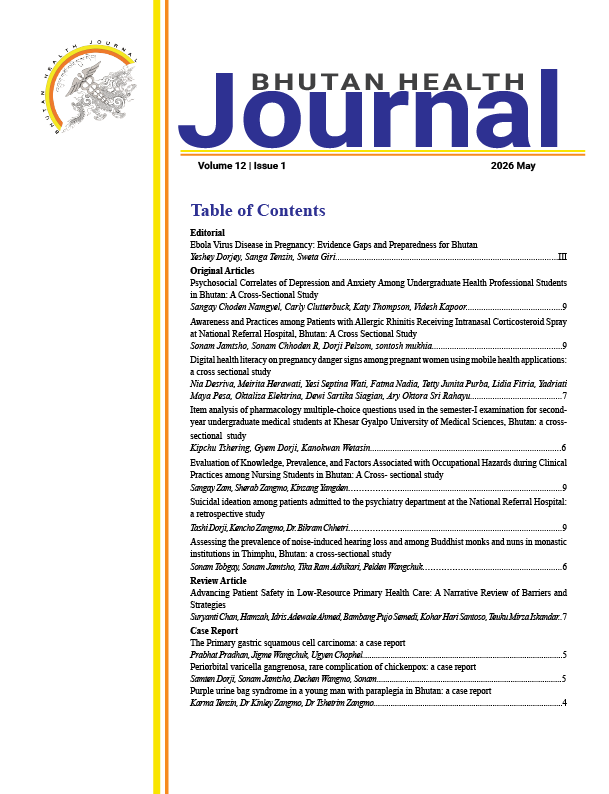
Evaluation of Knowledge, Prevalence, and Factors Associated with Occupational Hazards during Clinical Practices among Nursing Students in Bhutan: A Cross- sectional study
DOI:
https://doi.org/10.47811/bhj.196Keywords:
Bhutan; Hepatitis B vaccine; Nursing Education; Nursing Student; Occupational exposureAbstract
Introduction: Occupational health hazards are risks and unsafe conditions that can harm individuals in the workplace. Nursing students face various occupational hazards during clinical placement, exposing them to risks such as infection, injury and psychological hazards. This study aimed to determine the level of knowledge on occupational hazards and evaluate the prevalence and factors associated with occupational hazards during clinical practices among nursing students.
Methods: A descriptive cross-sectional study was conducted from March 2023 to June 2024 among nursing students enrolled in the Apollo Bhutan Institute of Nursing, Arura Academic of Health Sciences, Faculty of Nursing and Public Health, and the Royal Thimphu College. Data was collected using a self-administered questionnaire. The questionnaire included items related to physical, mechanical and psychological hazards as well as demographic variables.
Results: Among 654 students, a high level of knowledge was reported regarding occupational hazards-specifically, needle-prick and sharp injuries (87.5%), falls due to slippery floor (92%) and psychological stress (94.2%). Logistic regression revealed that age was a strong and significant predictor of good knowledge score, whereas gender, institute and category were not associated with knowledge levels. The overall prevalence of exposure to physical, mechanical, and psychological hazards was found to be 81.2%, 70%, and 75.9%, respectively.
Conclusion: The study demonstrated a high level of knowledge among nursing students regarding occupational hazards. However, the prevalence of exposure to physical, mechanical, and psychological risks remains substantial. These findings underscore the need to strengthen clinical supervision, manage clinical workload, and prioritize Hepatitis B vaccination by the institutions.
Published
Issue
Section
License
Copyright (c) 2026 Sangay Zam, Sherab Zangmo, Kinzang Yangden

This work is licensed under a Creative Commons Attribution 4.0 International License.
BHJ allow to read, download, copy, distribute, print, search, or link to the full texts of its articles and allow readers to use them for any other lawful purpose. The author(s) are allowed to retain publishing rights without restrictions.