PERSPECTIVE
https://doi.org/10.47811/bhj.205
Perinatal mental health services at the National Referral Hospital, Bhutan
Dema1, Bikram Chhetri1, Ugyen Dem1
1 Department of Psychiatry, Jigme Dorji Wangchuck National Referral Hospital, Thimphu, Bhutan
Corresponding author:
Dema
Email: norbudem99@gmail.com../Telegram Desktop/sangayzam77@fnph.edu.bt
ABSTRACT
Maternal mental health is a critical determinant of both maternal and child well-being. Mental health disorders during the perinatal period have wide-ranging consequences, affecting not only the mother’s physical and psychological health but also the child’s growth, development, and long-term outcomes, as well as overall family functioning. Systematic screening during the perinatal period facilitates early identification of mental health problems and enables timely intervention, thereby improving outcomes for both mothers and their children. This paper aims to describe the maternal and child mental health screening programs and the associated mental health services available at the National Referral Hospital in Bhutan.
Key words: Bhutan; Maternal Health; Mental Health Services; Perinatal Period.
INTRODUCTION
Maternal mental health refers to a mother’s psychological well-being during pregnancy and the postpartum period, including her ability to cope with stress, function effectively, and care for herself and her child, as defined by the World Health Organization. It is a critical component of overall maternal and child health, influencing not only the mother’s quality of life but also infant development and family well-being1.
Perinatal mental health disorders, particularly depression and anxiety, are among the most common complications of pregnancy and childbirth. Globally, an estimated 10–20% of women experience such conditions, with higher rates reported in low- and middle-income countries due to factors such as poverty, limited social support, and exposure to stress or adversity2,3.These disorders can lead to significant consequences, including increased maternal morbidity, poor birth outcomes, impaired mother–infant bonding, and long-term developmental challenges in children4.
Recognizing these impacts, maternal and child mental health screening services were introduced in May 2023 by the Department of Psychiatry at the Jigme Dorji Wangchuck National Referral Hospital (JDWNRH )in Thimphu. This paper highlights the importance of such services and explores the need to expand similar programs across the country to strengthen early detection, prevention, and care for maternal and child mental health.
Integration of mental health services at Mother and Child hospital
Bhutan is a landlocked country between India and China. As of 2025, its population was approximately 796,682, with a median age of 30.5 years, reflecting a young demographic structure. Around 20% of Bhutan’s population is under 15 years old, and over 70% falls within the working-age group5,6.
The Gyaltsuen Jetsun Pema Wangchuck Mother and Child Hospital (GJPWMCH), formerly the Mother and Child Health (MCH) unit established in 1974 under JDWNRH, serves as Bhutan’s main center for maternal and child healthcare services. In May 2023, the Department of Psychiatry initiated perinatal mental health screening services at GJPWMCH, where mental health professionals, particularly clinical counselors, conduct twice-weekly screening of antenatal and postnatal mothers using standardized tools such as the Edinburgh Postnatal Depression Scale (EPDS), Patient Health Questionnaire (PHQ-9), Generalized Anxiety Disorder scale (GAD-7), Adverse Childhood Experiences (ACE) questionnaire, and CAGE survey. The service also incorporates psychoeducation and parenting support to promote maternal mental wellbeing and early identification of at-risk mothers7,8.
As illustrated in Figure 1, between 2023 and 2024, a total of 2,755 perinatal mothers were screened for mental health and developmental concerns7,8.
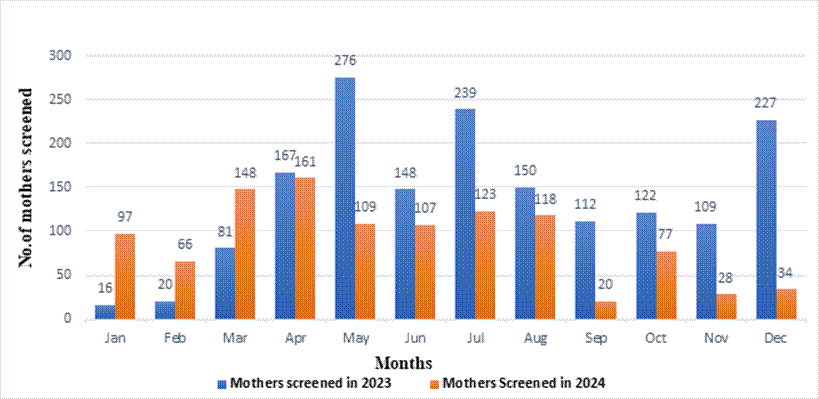
Figure 1: Number of pregnant mothers screened monthly for mental health at the MCH unit of the National Referral Hospital, Bhutan, 2023-2024
As depicted in Figure 2, anxiety and stress-related conditions were the most commonly identified concern, followed by depressive, mood-related, and psychosocial difficulties. Routine mental health screening is now conducted by MCH professionals in antenatal and postnatal clinics at the GJPWMCH, facilitated by the integration of mental health screening tools into perinatal health handbooks. Mothers requiring specialized care get referred to the Psychaitric Department.
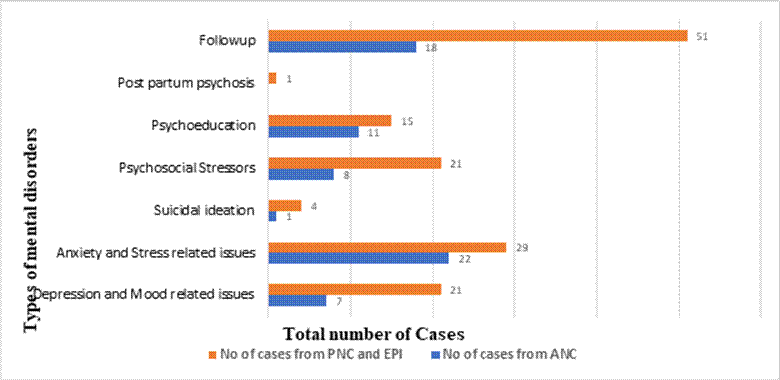
Figure 2: Mental health disorders detected and intervention provided during the antenatal and postnatal follow-up visits at Maternal and Child Healthcare Unit, at the National Referral Hospital, Bhutan, 2023-2024
As depicted in Figure 3, between January 2023 and May 2024, 815 children aged 9 months to 3 years were screened using the Modified Checklist for Autism in Toddlers (M-CHAT) and the Vanderbilt Assessment Scale before the service transitioned to the Care for Child Development Unit. Most referrals were related to speech and language delays, followed by autism spectrum disorder (ASD) and attention-deficit/hyperactivity disorder (ADHD), highlighting the importance of early identification and intervention in maternal and child mental health services.
This initiative represents the first integrated maternal and child mental health program launched by the Department of Psychiatry, with future plans to expand services, train additional staff, and extend the program to other districts.

Figure 3: Mental health disorders detected in children at Maternal and Child Healthcare Unit, at the National Referral Hospital, Bhutan, 2023-2024
Challenges
Limited access to services
Perinatal mental health services in Bhutan remain highly centralized. The Department of Psychiatry at JDWNRH serves as the main referral center for psychiatric care, including perinatal cases referred from maternal health services. Outside the capital, specialist coverage is minimal, with only one psychiatrist based in the southern region and several districts relying primarily on clinical counselors. This uneven distribution of human resources limits early identification and continuity of care at the community level9,10.
Figure 3: Mental health disorders detected in children at Maternal and Child Healthcare Unit, at the National Referral Hospital, Bhutan, 2023-2024
Inadequate integration of mental health into maternal care
Mental health remains insufficiently integrated into routine maternal healthcare services, despite the need for holistic care during the perinatal period2,11,12. Comprehensive maternal mental health services are largely concentrated at GJPWMCH. Although the Edinburgh Postnatal Depression Scale (EPDS) is included in the Maternal and Child Health (MCH) handbook for routine antenatal and postnatal screening, its implementation remains inconsistent. Key challenges include limited availability of trained mental health professionals, inadequate capacity of frontline health workers, high service workload, and competing clinical priorities, which hinder systematic integration of maternal mental health.
Stigma and cultural barriers
Perinatal mental health is significantly influenced by stigma and cultural norms that idealize motherhood as a uniformly positive experience. Evidence from multiple qualitative studies, including a meta-analysis of 27 studies across diverse settings, highlights women suppressing distress due to fear of judgment and internalized beliefs equating maternal difficulty with failure and poor parenting13,14,15,16. Such overt and perceived stigma, alongside cultural expectations of maternal emotional resilience, act as major barriers to disclosure and help-seeking in perinatal mental health care. Studies from South Asian contexts similarly report that stigma and culturally embedded beliefs substantially hinder access to available mental health services17,18.
Lack of mental health literacy and awareness
Limited mental health literacy among healthcare providers and general population contributes to the under recognition and undertreatment of perinatal mental health conditions, resulting in a persistent gap between service need and availability. This is further reflected in empirical findings from Bhutan, where a cross-sectional study on postpartum depression reported that higher maternal educational attainment was positively associated with increased likelihood of seeking mental health services, underscoring how variations in awareness and understanding directly influence help-seeking behavior and service utilization in the perinatal period19.
Socioeconomic disadvantages
Socioeconomic factors further compound perinatal mental health vulnerability. In Bhutan, intimate partner violence affects a substantial proportion of women, and alcohol use is a recognized contributor to household conflict and domestic violence. Notably, available Bhutanese data indicate that 4.2% of women report experiencing physical violence during pregnancy, underscoring the persistence of violence within the perinatal period. Women with absent spouses often experience reduced caregiving and social support, limiting access to perinatal services20,21.
Limited research and data
The scarcity of locally generated evidence limits the development of contextually appropriate maternal mental health interventions and policies4,13,22. Although global literature on perinatal mental health is extensive, the limited availability of Bhutan-specific research constrains the adaptation of evidence-based practices to local sociocultural realities, including the refinement of screening tools and service models.
Identify shifts and unacknowledged grief
The transition to motherhood involves a significant shift in personal identity. Loss of previous roles and expectations, combined with societal pressures to experience motherhood positively may contribute to emotional distress, guilt, and unacknowledged grief. Bhutanese evidence also suggests that mothers who report negative birth experiences, heightened postnatal stress, or distress related to bodily changes are at increased risk of postpartum depression19.
Way Forward
A coordinated approach that combines policy integration, workforce capacity building, contextually adapted service delivery, and strengthened local research is essential to establish accessible and sustainable perinatal mental health services across Bhutan. Such efforts would enable early identification, timely intervention, and improved maternal and child health outcomes at a national level.
Evidence from low- and middle-income countries supports the integration of maternal mental health into routine care through non-specialist, primary care–based approaches. Building on this, the following actions are proposed in relation to the identified challenges in Bhutan.
Expanding access to services
To address the highly centralized nature of care, perinatal mental health services need to be decentralized beyond the national referral center. Strengthening district-level services through clinical counselors and integrating basic perinatal mental health care within primary health services would improve early identification and continuity of care.
Strengthening integration into maternal care
Given inconsistent implementation of screening within MCH services, routine perinatal mental health screening and monitoring should be standardized across antenatal and postnatal care. Clear referral pathways between MCH services and psychiatric care are essential to ensure continuity between screening and specialist support.
Addressing stigma and improving literacy
To reduce stigma and improve help-seeking, perinatal mental health should be normalized within maternal care interactions through routine psychoeducation. Strengthening mental health literacy among mothers, families, and frontline health workers is critical to improving disclosure and early engagement with services.
Building workforce capacity
Given the limited number of specialists, structured training and supervision of existing MCH staff is essential to support identification and basic management of perinatal mental health conditions at primary care level.
Strengthening evidence and local data
To address gaps in Bhutan-specific evidence, investment in routine data collection and implementation research is required to guide adaptation of screening tools, referral pathways, and service models to the local context.
CONCLUSION
Bhutan’s first integrated perinatal and child mental health service at JDWNRH highlights the value of early detection, standardized screening, and integrated care. By promoting timely identification, reducing stigma, and strengthening parenting support, it provides a strong model for nationwide scale-up. Expanding such services to other hospitals is now an urgent healthcare priority.
REFERENCES
1. Atif N, Lovell K, Rahman A. Maternal mental health: The missing “M” in the global maternal and child health agenda. Semin Perinatol. 2015;39(5):345–52. [PubMed] [DOI]
2. Tripathy P. A public health approach to perinatal mental health: Improving health and wellbeing of mothers and babies. J Gynecol Obstet Hum Reprod. 2020;49(6):101747. [PubMed] [Full Text] [DOI]
3. Satyanarayana VA, Lukose A, Srinivasan K. Maternal mental health in pregnancy and child behavior. Indian J Psychiatry. 2011;53(4):351-61. [PubMed] [Full Text] [DOI]
4. Engle PL. Maternal mental health: Program and policy implications. Am J Clin Nutr. 2009 ;89(3): 963S–966S. [Full Text] [DOI]
5. World Health Organization. Population dynamics and data. Available from: https://bhutan.unfpa.org/en/topics/population-dynamics-and-data [cited 10 May 2025].
6. Worldometer. Bhutan population. Available from: [Full Text]
7. Jigme Dorji Wangchuck National Referral Hospital. Annual Report 2023. Thimphu, Bhutan. Jigme Dorji Wangchuck National Referral Hospital; 2023.
8. Jigme Dorji Wangchuck National Referral Hospital. Annual Report 2024. Thimphu, Bhutan. Jigme Dorji Wangchuck National Referral Hospital; 2024.
9. Gyeltshen K, Chhetri B, Gyeltshen D. Delivery of Mental Health Services in Bhutan: Challenges and Way Forward. Public Health Chall. 2024 J;3(3):e211. [PubMed] [Full Text] [DOI]
10. Pelzang R. Mental health care in Bhutan: policy and issues. WHO South East Asia J Public Health. 2012;1(3):339-346. [PubMed] [Full Text] [DOI]
11. McNab S, Fisher J, Honikman S, Muvhu L, Levine R, Chorwe-Sungani G, et al. Comment: Silent burden no more: A global call to action to prioritize Perinatal Mental Health. BMC Pregnancy Childbirth. 2022;22(1). [PubMed] [Full Text] [DOI]
12. Yang K, Wu J, Chen X. Risk factors of perinatal depression in women: a systematic review and meta-analysis. BMC Psychiatry. 2022;22(1):63. [PubMed] [Full Text] [DOI]
13. Baldisserotto ML, Miranda Theme M, Gomez LY, Dos Reis TBQ. Barriers to Seeking and Accepting Treatment for Perinatal Depression: A Qualitative Study in Rio de Janeiro, Brazil. Community Ment Health J. 2020;56(1):99-106. [PubMed] [DOI]
14. Law S, Ormel I, Babinski S, Plett D, Dionne E, Schwartz H, et al. Dread and Solace: Talking about Perinatal Mental Health. Int J Ment Health Nurs. 2021;30(S1):1376–85. [PubMed] [Full Text] [DOI]
15. Mauthner NS. `It’s a woman’s cry for help’: A relational perspective on postnatal depression. Feminism Psychol. 1998;8(3):325–355. [DOI]
16. Scharp KM, Thomas LJ. “What would a loving mom do today?”: Exploring the meaning of motherhood in stories of prenatal and postpartum depression. J Fam Commun. 2017;17(4):401–414. [DOI]
17. Sato S. Mental Health Infrastructure and stigma in South Asia: Barriers to mental health services in Bhutan and Sri Lanka. 2024. [Full Text] [DOI]
18. Namgyel S, Milbert M. The Bhutanese Context on Mental Health. The Druk Journal. 2021;7(2):46-56. [Full Text]
19. Zangmo S, Boonchieng W, Suvanayos C, Gyeltshen K, Siewchaisakul P. Prevalence and factors associated with postpartum depression among Bhutanese mothers: a cross-sectional study. Womens Health Nurs. 2024;30(3):238-249. [PubMed] [Full Text] [DOI]
20. Royal Government of Bhutan. National strategy and framework of action on the elimination of gender-based violence in Bhutan (2024–2028). National Commission for Women and Children (NCWC), Royal Government of Bhutan. [Full Text]
21. Royal Government of Bhutan. National Study on Women’s Health and Life Experiences 2017: A Study on Violence against Women and Girls in Bhutan. National Commission for Women and Children (NCWC), Royal Government of Bhutan. [Full Text]
22. Rahman A, Surkan PJ, Cayetano CE, Rwagatare P, Dickson KE. Grand challenges: integrating maternal mental health into maternal and child health programmes. PLoS Med. 2013;10(5):e1001442. [PubMed].[Full Text] [DOI]
|
AUTHORS CONTRIBUTION Following authors have made substantial contributions to the manuscript as under: D: Conceptualization, literature review, editing and reviewing, original article BC: Conceptualization, literature review, editing and reviewing, original article UD: Conceptualization, editing and reviewing Authors agree to be accountable for all respects of the work in ensuring that questions related to the accuracy and integrity of any part of the work are appropriately investigated and resolved. |
|
CONFLICT OF INTEREST None GRANT SUPPORT AND FINANCIAL DISCLOSURE None |